Istegnuće zadnje lože je djelomičan razdor mišića stražnje strane bedra koji najčešće nastaje na mišićnotetivnom spoju.
Istegnuća mišića zadnje lože su uobičajena među trkačima. Visokorizični su sportaši s lošom fleksibilnošću zadnje lože, neadekvatnim zagrijavanjem prije treninga te s prijašnjom ozljedom u anamnezi. Stariji sportaši su također izloženi većem riziku. Kao i kod drugih istegnuća mišića, iznos sile koja je uzrokovala razdor određuje stupanj ozljede.
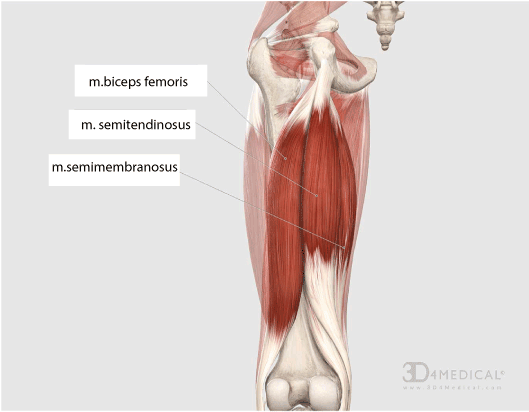
Mišići zadnje lože.
|
Mišići zadnje lože su 3 mišića stražnje strane bedra: semimembranosus, semitendinosus i biceps femoris.
|
Simptomi i znakovi
Simptomi i znakovi istegnuća mišića zadnje lože
Istegnuće mišića zadnje lože može se manifestirati kako akutna bol u području stražnje strane bedra prilikom trčanja ili se može razviti puno sporije, najčešće radi neadekvatnog treninga fleksibilnosti.
Dijagnoza
Dijagnoza istegnuća mišića zadnje lože
Dijagnoza se postavlja uz nalaz bolnosti u području stražnje lože uz fleksiju koljena protiv otpora, kao i na palpaciju stražnje strane bedra. Pri blagom istegnuću prisutna je osjetljivost i blagi otok. U težim slučajevima prisutne su ekhimoze, umjeren do jak otok, te oslabljena mišićna funkcija uzrokovana bolovima.
Liječenje
Liječenje istegnuća mišića zadnje lože
Liječenje ledom i kompresijama s korištenjem steznika za natkoljenicu treba započeti što je prije moguće. NSAR i analgetike treba propisati po potrebi, a u početku može biti potrebno i korištenje štaka ako se javlja bolnost prilikom hoda.
Kada dođe do prestanka bolova pacijent treba započeti lagane vježbe istezanja mišića stražnje lože. Postupno jačanje mišića kvadricepsa i mišića stražnje lože treba započeti kada bolovi potpuno nestanu.
S treningom treba nastaviti tek kada je postignuta zadovoljavajuća snaga mišića. Sportaše treba uputiti da oporavak nakon ozljede mišića stražnje lože može potrajati do nekoliko mjeseci, ovisno o težini ozljede.
Vježbe za jačanje i rastezanje mišića stražnje ložeSquats
1. Stand with feet about hip width apart.
2. Toes should point forward to stay aligned with the knees.
3. Keeping core tight, move buttocks backward, similar to beginning to sit in a chair, and squat down until the thighs are almost parallel with the floor.
4. Return to start position and repeat.
5. Perform 3 sets of 10 repetitions, 1 time every other day.
6. Special Instructions
a. Keep weight on outside of foot and heels.
b. Start with a partial squat and increase as you become familiar with the movement.
c. Add weight only as tolerated. Start with 1 to 2 pounds (0.5 to 1 kg [ie, a soup can]).
Courtesy of Tomah Memorial Hospital, Department of Physical Therapy, Tomah, WI; Elizabeth C.K. Bender, MSPT, ATC, CSCS; and Whitney Gnewikow, DPT, ATC.
Supine Active Hamstring Stretch
1. Lie on back, hold behind the involved knee to pull it gently toward the chest.
2. Gently extend the knee to straighten the leg.
3. Hold exercise for 30 sec.
4. Perform 1 set of 4 repetitions, 3 times a day.
5. Repeat on the other leg.
Courtesy of Tomah Memorial Hospital, Department of Physical Therapy, Tomah, WI; Elizabeth C.K. Bender, MSPT, ATC, CSCS; and Whitney Gnewikow, DPT, ATC.
Bridging
1. Lie on back with both knees bent and feet on floor/table.
2. Perform abdominal and gluteus maximus contraction and lift buttocks off floor.
3. Keep legs in neutral position.
4. Return to start position.
5. Perform 3 sets of 10 repetitions, 1 time a day.
6. Special Instructions
a. Maintain neutral spine.
b. For added resistance place a band just above the knees. Start with least resistance band.
Courtesy of Tomah Memorial Hospital, Department of Physical Therapy, Tomah, WI; Elizabeth C.K. Bender, MSPT, ATC, CSCS; and Whitney Gnewikow, DPT, ATC.
Prone Resisted Knee Flexion
1. Once the inflammatory phase has subsided and the patient is able to perform knee flexion without pain:
2. Lie on stomach.
3. Begin with knee straight.
4. Bend knee through available range that is pain free.
5. Slowly return to starting position.
6. Perform 3 sets of 10 repetitions, 1 time a day.
7. Special Instructions
a. Start with least resistance, adding weight as tolerated. Band resistance can also be used.
b. Focus on eccentric lowering phase with a count of 4 to lower and extend knee to starting position and a count of 2 for knee flexion.
Courtesy of Tomah Memorial Hospital, Department of Physical Therapy, Tomah, WI; Elizabeth C.K. Bender, MSPT, ATC, CSCS; and Whitney Gnewikow, DPT, ATC.